Executive Summary
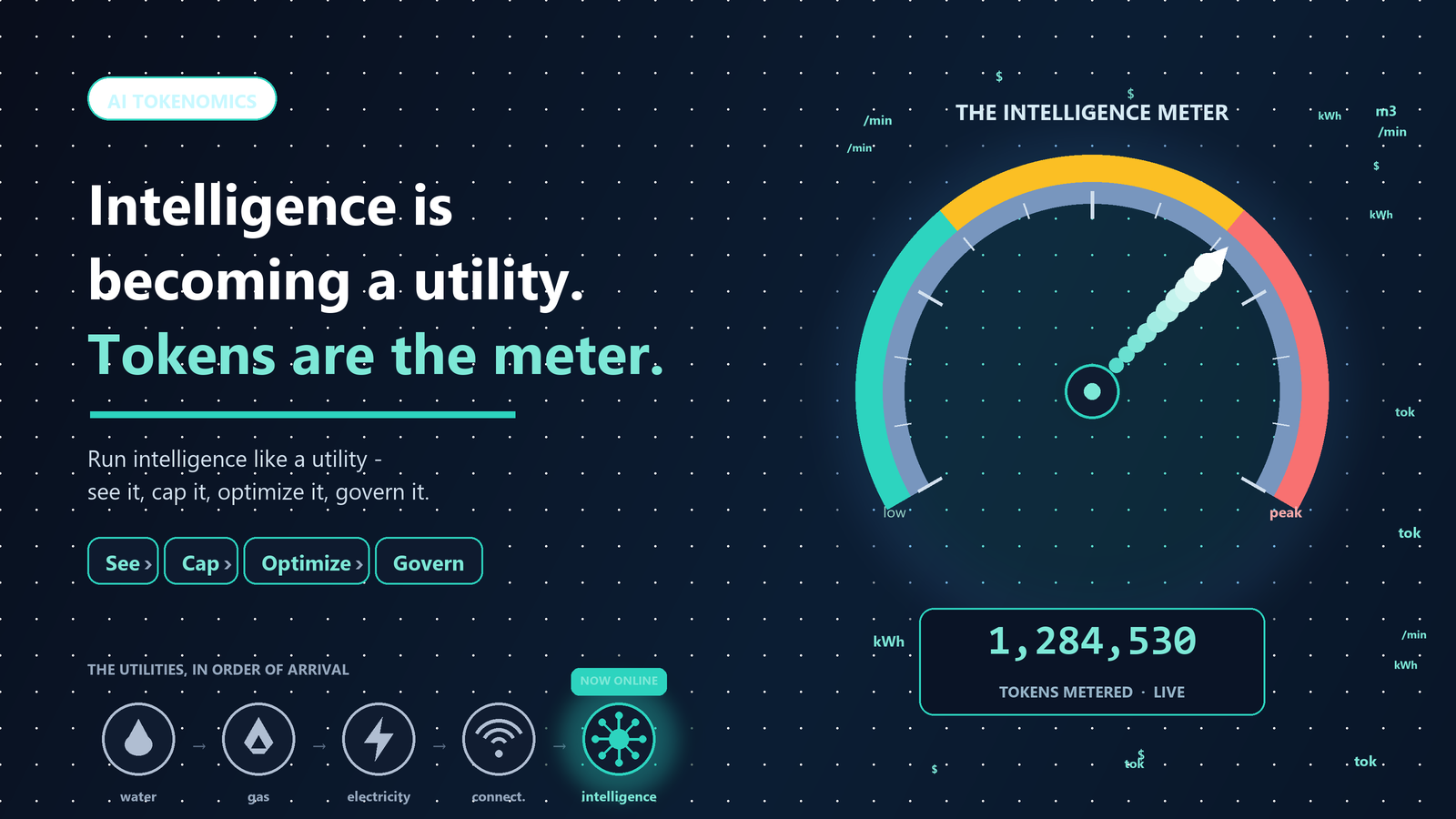
- The big idea: Intelligence has quietly joined water, gas, electricity, and telecommunications as a metered utility. Its unit is the token – the kilowatt-hour of cognition – and by default, nothing caps the meter.
- The misread to drop: “AI cost is a model-price problem.” No utility was ever run by haggling over the price of one electron. You run it with a meter, a breaker panel, and a control room.
- The trap: Cost is invisible in a pilot and existential at scale. Consumption grows multiplicatively – users x agents x steps x retries x context – so the controls you skip become load-bearing the month you finally succeed.
- Two meters, two control rooms: raw tokens (your LLM calls, metered by the API Management AI gateway) and Copilot Credits (Microsoft’s packaged experiences, governed in the Microsoft 365 Cost Management dashboard). Different tools, different owners – govern both.
- The move: Stand up a token control plane – See, Cap, Optimize, Govern – before you scale. On the Microsoft stack that’s API Management as the meter and breaker, Foundry as smart-grid dispatch, PTUs as baseload, and Cost Management as the bill you can finally read.
- Why it matters to you: Electrification rewarded the operators who metered and managed power, not the ones who shopped for the cheapest supply. The AI era will sort winners the same way.
The bill nobody read
Here is a scene you’ll recognize soon, if you don’t already (illustrative, anonymized). A bank ships a support copilot. It works – so three teams start drawing on the same model deployment. Within a month, two things happen at once: at peak hours the shared capacity browns out and requests start failing, and the invoice triples with no way to say which team caused it. Nobody did anything reckless. They simply ran a utility with no meter on the wall.
That word – utility – is the one most leaders are still missing. Over the last century we industrialized water, gas, electricity, and then telecommunications into utilities: services so essential we regulated them and billed them by the drop, the therm, the kilowatt-hour, the gigabyte. (The United States went as far as classifying broadband a public utility in 2015.) They share a signature: essential, delivered on tap over a network, metered, and billed by what you consume.
Intelligence now fits that signature exactly – and its unit of consumption is the token, the kilowatt-hour of cognition. The meter ticks on every prompt, every retry, every step an agent takes on your behalf. A server you buy once; intelligence you draw continuously. And an agentic workload bills per conversation times every tool call and reasoning hop along the way.
Which is why “just pick a cheaper model” is the wrong first move. You don’t run an electric grid by shopping for cheaper electrons. You meter it, you protect it with breakers, you dispatch it intelligently, and you put someone in charge of the control room. Call that discipline AI Tokenomics – running intelligence like the utility it has quietly become.
Pilots lie
A pilot is a flattering liar. Ten friendly users, a few hundred calls a day, a bill you could settle from petty cash – so nobody installs a meter. Then you go to production and the arithmetic changes shape. Enterprise scale is not the pilot times a constant; it is multiplicative. More users, each running more agents, each taking more steps, each step retried, each prompt dragging a longer context window – and every factor multiplies the others. The workload that was a rounding error in the demo becomes your largest variable line item in production.
That is the cruel timing of token economics: governance is easiest to install when consumption is trivial, and indispensable when it isn’t. You cannot retrofit a meter, a breaker panel, and a dispatch strategy onto a live grid at peak load without an outage or a budget shock. The move from pilot to production is precisely where AI programs either scale – or freeze, strangled by their own bill. Build the control plane on the path to production, not in the post-mortem after it.

The intelligence grid: demand draws through the Azure API Management gateway (meter + breaker) into Microsoft Foundry (dispatch + capacity), with telemetry to Azure Monitor and Cost Management. Two meters, two control rooms: raw tokens via the API Management gateway, and Copilot Credits via the Microsoft 365 Cost Management dashboard – both rolling into one AI P&L.
The control room has four dials
Good news: the control room already exists across the Microsoft stack, and it has four dials that build on one another.
1. See – the meter
You cannot govern what you cannot measure, and no default dashboard tells you who drew how much, on what, and why. For the raw token consumption of your own LLM calls – apps and agents hitting Azure OpenAI or other models – put every call behind one front door: the AI gateway in Azure API Management. That gateway is purpose-built to meter token usage: it emits token-usage metrics into Azure Monitor and Log Analytics, dimensioned by app, team, or department; pair it with Microsoft Cost Management tags for showback and chargeback, and the single frightening number resolves into a per-team story. Meter first. Every other dial reads from this one. (Packaged agent experiences bill differently – more on that below.)
2. Cap – the breaker panel
A meter records what happened; a breaker decides what’s allowed to. API Management’s token-limit policy enforces a tokens-per-minute ceiling and a longer quota – by the hour, day, month, or year – against any key you choose, and it pre-calculates prompt tokens so an over-limit request is stopped before it bills the model. That is the antidote to the bank’s brownout: no single team can drain the shared supply. Close the loop at the wallet with Cost Management budgets and anomaly detection that flag a spike the day it starts. Gateway limits stop runaway load; budgets stop runaway cost.
3. Optimize – the smart grid
A modern grid doesn’t burn premium fuel for every watt; it dispatches the cheapest source that meets demand, stores what it can, and shifts flexible work to off-peak. Intelligence gets the same three levers, all native:
- Dispatch: the model router in Microsoft Foundry routes each prompt, in real time, to the most cost-effective model that still clears a quality bar – a small model for the easy asks, a frontier or reasoning model only when the task earns it. Choose the posture (Balanced, Cost, or Quality); it honors data-zone boundaries, which matters when you’re regulated.
- Storage: semantic caching at the gateway reuses answers to similar prompts; prompt caching in Foundry discounts the repeated prefix of long prompts. Don’t regenerate power you already made.
- Off-peak: the Batch API runs anything that doesn’t need an instant answer asynchronously, at roughly half the standard per-token rate.
The operating rule: cheap-and-cached by default, frontier-and-synchronous by exception.
4. Govern – contracts, code, and an operator
Every mature utility runs on contracts, a code, and someone accountable. Match buying to load shape: Provisioned Throughput (PTUs) are your baseload – dedicated capacity at a predictable hourly price – while pay-as-you-go is the peaker plant for bursts. Enforce the code with Azure Policy (allowed regions, deployment types, mandatory cost tags) so governance is built in, not begged for. And the decisive act isn’t a feature at all: name a human operator for the intelligence grid – an owner of the AI P&L who reads the token bill the way finance reads cloud spend, and runs the loop: inform, optimize, operate.
Two meters, two control rooms
Here’s the twist most cost models miss – and the distinction most people get wrong. There are two different meters, and they live in two different places. Confuse them and you’ll govern one while the other runs wild.
Meter one – raw tokens (the developer’s control room). When your own apps and agents call an LLM directly – Azure OpenAI or another model in Microsoft Foundry – you’re billed per token. That’s what the API Management AI gateway is for: metering, limiting, caching, and routing token consumption at the request level. This is the meter engineers and platform teams operate.
Meter two – Copilot Credits (the admin’s control room). Microsoft’s packaged AI experiences – Microsoft 365 Copilot usage-based scenarios, Copilot Studio agents, Cowork, the Work IQ API – don’t bill you in raw tokens. They meter in Copilot Credits, a common usage-based-billing currency, and you govern them not in API Management but in the Microsoft 365 admin center’s Cost Management dashboard: allocate credits, set spending policies and per-user limits, choose prepaid or pay-as-you-go, and enforce budgets, alerts, and hard caps. Different surface, different owner (billing/AI admins), different reports.
The lesson for leaders: don’t try to read credits on the token meter, or tokens on the credit meter. Your engineers watch token consumption through the API Management gateway; your admins watch Copilot Credit spend through the Microsoft 365 Cost Management dashboard. Both roll up into one AI P&L – but only if someone owns both dials. The meter you don’t read is the one that surprises you.
What to do Monday
- One front door. Route every model call through the API Management AI gateway. Direct-to-endpoint traffic is an unmetered leak.
- Read both meters, in both places. Turn on token metrics and cost tags in the API Management gateway this week; if you use Microsoft 365 Copilot usage-based experiences or Copilot Studio agents, open the Microsoft 365 admin center Cost Management dashboard and set credit spending policies too.
- Set the breakers. Add token limits per app or team and a budget with anomaly alerts before the next pilot scales.
- Dispatch smart. Make model router (Balanced) plus caching the default path; reserve frontier models for tasks that earn them.
- Contract and assign. Cover the baseline with PTUs and bursts with pay-as-you-go – and put one name against the AI P&L.
The honest part
No control room is free of trade-offs, and this isn’t a Microsoft-only idea. The gateway is a new dependency – design it multi-region with circuit breakers and load balancing so it never becomes a single point of failure, and expect it to add some latency you’ll want to measure. Semantic caching can serve a stale or subtly wrong answer if the similarity threshold is loose; tune it, log cache hits, and exclude regulated flows. Over-provisioned PTUs are idle baseload burning cash, so size them from real telemetry. Chargeback is as much politics as engineering and needs executive air cover. And the newest gateway conveniences (a unified multi-provider API; the gateway embedded directly in Foundry) are in preview as of July 2026 – pilot them, but confirm general availability before betting production on them.
Credit where due: the same discipline runs on other stacks – Amazon Bedrock and AWS budgets, Google’s Vertex AI, and independent AI gateways such as Kong, Portkey, LiteLLM, and Cloudflare AI Gateway all offer versions of routing, caching, limits, and observability. The pattern is portable; I use the Microsoft stack here because today it stitches the meter, the breaker, dispatch, capacity, and the bill into one control room with the least glue code.
The bottom line
Electrification split the world into the electrified and the dark, and it rewarded the operators who metered and managed power over the ones who chased the cheapest supply. Intelligence is now climbing the same curve. AI Tokenomics is how you run the utility instead of merely paying for it – and the test arrives at the pilot-to-production line, where consumption stops being a rounding error and becomes the number that decides whether you scale or stall. For regions still writing their AI story – LATAM included – a metered, governed, affordable intelligence grid is a real chance to leapfrog. The organizations that thrive won’t own the cheapest model. They’ll be the ones who built the control room before they turned the grid on for everyone.
FAQ
Is this just cloud FinOps with a new name? Same discipline, harder grid. Token draw is finer-grained and shaped by prompt design and agent behavior – one chatty agent can move the bill in ways a VM never could.
Do agent “credits” replace tokens – and are they the same meter? No, and no. They’re two different meters in two different tools. The API Management AI gateway meters raw token consumption for the LLM calls your own apps and agents make. Copilot Credits are a usage-based-billing currency for Microsoft’s packaged experiences (Microsoft 365 Copilot usage-based scenarios, Copilot Studio, Cowork, Work IQ API) and are governed in the Microsoft 365 admin center Cost Management dashboard – separate policies, limits, and reports. Govern both; don’t expect one console to show the other.
Won’t a gateway slow everything down, and do I need a premium tier? A gateway adds a network hop, so measure the latency and design for resilience (multi-region, circuit breakers). Capability varies by API Management tier, so validate the specific policies you need before you standardize on one.
What about models that aren’t on Azure? The same control plane can front third-party and self-hosted models; treat every provider as another feeder into the same meter, breaker, and bill rather than a separate, ungoverned pipe.
If I do only one thing first? Install the meter – the gateway plus token metrics. You can’t run a utility you can’t see.
Go deeper
- AI gateway capabilities in Azure API Management – token limits, semantic caching, monitoring for LLM token consumption. https://learn.microsoft.com/en-us/azure/api-management/genai-gateway-capabilities
- Model router in Microsoft Foundry – real-time, cost-optimized model dispatch. https://learn.microsoft.com/en-us/azure/ai-foundry/openai/concepts/model-router
- Copilot Credits & usage-based billing (Microsoft 365 Cost Management dashboard) – how packaged AI experiences are metered and governed. https://learn.microsoft.com/en-us/microsoft-365/copilot/usage-based-billing-overview-copilot-credits
Leave a Reply