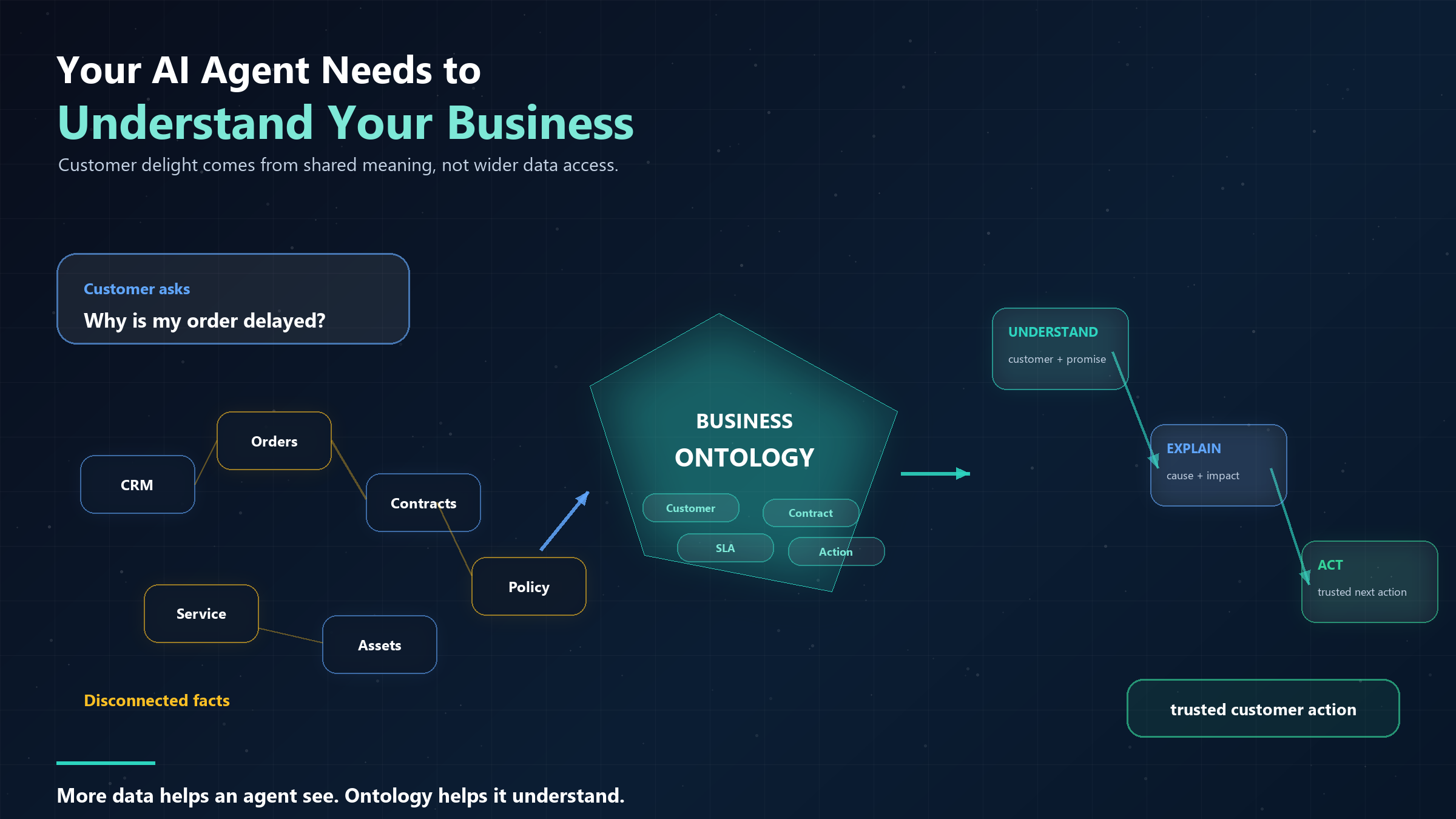
The best customer experience in the AI era will not come from agents that can access everything. It will come from agents that understand what everything means.
Executive Summary
- The myth to stop believing: weak AI answers are not always caused by missing data. Very often, the agent has plenty of data – but no shared understanding of customers, products, contracts, commitments, assets, risks, or service levels.
- The real problem for customers: when your business language is inconsistent, the customer feels it. They repeat information, receive conflicting answers, wait for handoffs, and lose trust in the experience.
- The shift that matters: ontology gives agents a business map. It defines the important things in your company, how they relate, what rules apply, and what actions are allowed.
- Why this is timely: Microsoft Fabric IQ now includes an ontology item in preview that can define enterprise concepts, bind them to OneLake data, connect to graph, and ground agents in business language.
- The leadership move: stop measuring agent readiness by how many sources it can reach. Measure it by whether it can explain the customer, the situation, the relationship path, and the next best action.
The customer does not care how many systems you connected
A customer asks a simple question:
“Why is my order delayed, and what are you going to do about it?”
Inside the company, that question is not simple. The order lives in one system. The shipment in another. The contract in a third. The service-level agreement somewhere else. The customer profile is split across sales, finance, support, and operations. The risk score may live in a model. The latest exception may be in a case note.
So we connect the AI agent to more data.
But the customer is not asking for more data. The customer is asking for understanding.
They want the agent to know which account matters, which order is affected, which promise was made, which exception applies, who owns the recovery, and what action is available now. If the agent cannot connect those meanings, it will respond like many companies already operate: politely, partially, and with another handoff.
The future of customer experience belongs to companies whose agents understand the business, not just the database.
More data can create a more confident mess
There is a dangerous pattern emerging in enterprise AI programs. When an agent gives a shallow answer, the instinct is to expand access: add the warehouse, add the lakehouse, add documents, add tickets, add CRM, add email summaries, add more PDFs to retrieval.
Access matters. But access without meaning creates a wider search area, not a smarter agent.
The agent may see five versions of “customer.” It may not know whether “active” means currently buying, contractually valid, operationally live, financially current, or simply not marked inactive. It may see “priority” in a dashboard, “strategic” in CRM, “premium” in a support system, and “managed” in a contract – and treat them as interchangeable.
That is how customers end up with confident but wrong answers.
This is not a model problem alone. It is a business-definition problem.
Ontology, in plain English
An ontology is a shared map of how your business works.
Not a data dictionary buried in a portal. Not a one-time enterprise architecture diagram. A living, governed model that tells people and AI agents:
- what the important things are: Customer, Order, Product, Contract, Shipment, Asset, Case, Policy, SLA;
- what facts describe them: status, owner, region, value, risk, priority, effective date;
- how they connect: Customer has Contract; Contract defines SLA; Order triggers Shipment; Asset causes Incident;
- what rules apply: a premium SLA has a response window; a retired asset cannot open a new work order; a customer commitment must have an owner;
- what actions are allowed: notify, escalate, reroute, approve, refund, schedule, renew, or open a case.
For a human, this sounds obvious. Humans carry these maps in experience, meetings, and tribal knowledge.
Agents do not.
If you do not give an agent a business map, it builds one on the fly from schemas, prompts, examples, and probability. That may be acceptable for a demo. It is not acceptable for a customer promise.

The understanding layer: ontology turns governed enterprise data into business meaning – entities, relationships, rules, lineage, and allowed actions – so customer-facing agents can understand, explain, and resolve instead of merely searching and summarizing.
A better customer answer starts with a relationship path
Imagine a support agent for an industrial equipment company. A customer asks why a compressor failure has not been resolved.
A basic AI assistant can summarize the case notes.
A better AI agent can traverse the business:
Customer -> Contract -> SLA -> Installed Asset -> Incident -> Work Order -> Technician Availability -> Recovery Action
That path changes the experience.
Instead of saying, “Your case is still open,” the agent can say:
“Your compressor is covered by a premium service agreement. The incident is linked to an installed asset at your Atlanta site. The work order missed the four-hour response target because the required certified technician was unavailable. The next available technician is scheduled for 2:00 PM, and I can escalate the SLA breach to your account owner now.”
That answer is not better because the model is larger. It is better because the agent understands the customer relationship, the contractual promise, the operational dependency, and the valid next action.
Ontology turns customer service from lookup to understanding.
Why this matters beyond service
The same pattern shows up everywhere customers feel friction.
In sales, an agent cannot recommend the right next offer unless it understands the relationship between account hierarchy, contract terms, product usage, renewal timing, and customer goals.
In healthcare, an assistant cannot support patient flow responsibly unless it understands the relationship between patient, appointment, clinician, room, equipment, consent, and care pathway.
In manufacturing, an operations agent cannot prioritize disruptions unless it understands how plant, asset, sensor, order, supplier, and customer commitment connect.
In financial services, a relationship agent cannot explain risk unless it understands household, product, policy, transaction, exception, and regulatory constraint.
The use cases differ. The pattern is the same: customers experience your ontology whether you designed it or not.
If your business meaning is fragmented, the customer experiences fragmentation. If your business meaning is clear, reusable, and governed, the customer experiences intelligence.
Where Microsoft Fabric fits
This is why the ontology work happening in Microsoft Fabric matters.
Fabric IQ is positioned as a business context layer for data and AI. In that model, OneLake helps unify data, Power BI semantic models preserve trusted analytical definitions, and ontology defines business entities, relationships, properties, rules, and actions. The goal is not simply to store more data. The goal is to elevate data into the language of the business so people and agents can reason over it.
As of this writing, the Fabric ontology item is in preview. It is designed to define enterprise concepts such as Customer, Shipment, Asset, or Contract; bind those concepts to real data in OneLake sources; represent relationships through Graph in Microsoft Fabric; and support natural-language questions over business terms instead of table names.
That is important because ontology has historically been difficult to operationalize. It often lived in specialist tooling or architecture documents far from the teams building customer experiences. Fabric changes the adoption path by placing ontology near the lakehouse, warehouse, eventhouse, semantic model, Power BI, Real-Time Intelligence, and Fabric Data Agent.
In practical terms, this means a company can start turning governed data into governed understanding – and then make that understanding available to agents.
Digital Twin Builder in Fabric shows the same idea in operational form. It lets teams model assets and processes through an ontology, map source data to that model, define semantic relationships, and connect the result to dashboards, analytics, machine learning, and generative AI experiences. For asset-heavy industries, that is the difference between seeing sensor readings and understanding the operational reality behind them.
The leadership test: can the agent explain the customer?
Before putting an AI agent in front of customers, leaders should ask a better readiness question.
Not: “Which systems can it access?”
Ask: “Can it explain the customer situation using our business definitions?”
Can it identify the right customer record? Can it distinguish the buyer from the ship-to location? Can it connect the contract to the service promise? Can it show the operational dependency behind a delay? Can it explain which rule allows or blocks an action? Can it tell the user where the answer came from?
If the answer is no, the agent is not ready for the customer. It may be ready for internal search. It may be ready for summarization. It may even be useful as a copilot for trained employees. But it is not yet a trusted representative of the business.
Customer-facing agents need more than language fluency. They need business fluency.
What gets hard
Ontology is not magic. It forces uncomfortable decisions.
Someone has to define what “customer” means. Someone has to resolve duplicate account hierarchies. Someone has to decide which system is authoritative for contract status. Someone has to maintain definitions as the business changes. Someone has to govern actions, not just answers.
That work is not glamorous. It is also exactly where trust is built.
The good news is that you do not need to model the entire enterprise before creating value. Start with one customer journey where the cost of misunderstanding is high: a delayed order, a service escalation, a renewal risk, a claims process, an outage response, a field repair, a patient appointment, a supply disruption.
Build the ontology required for that journey. Then expand.
What to do Monday
- Choose one customer moment that exposes fragmentation. Pick a journey where customers often repeat themselves, receive inconsistent answers, or wait for handoffs.
- Name the business objects behind that moment. Customer, contract, order, asset, case, SLA, policy, owner, action. Keep it practical.
- Map the relationship path. Draw how those objects connect from the customer’s question to the company’s response.
- Bind the path to governed data. Use trusted semantic models, OneLake sources, graph, and ontology capabilities where they fit.
- Test the agent on explanation, not just accuracy. A good answer should include the customer context, the evidence, the relationship path, and the action boundary.
The bottom line
AI will not delight customers simply because it speaks naturally. Customers have heard natural language from broken processes for years.
What changes the experience is an agent that understands the business well enough to explain, decide, and act responsibly.
That requires more than data access. It requires a well-architected ontology: a shared, governed understanding of customers, commitments, assets, policies, relationships, and actions.
The winners will not be the companies that connect the most systems to an agent. They will be the companies that teach the agent how the business actually works.
More data helps an agent see.
Ontology helps it understand.
FAQ
Is ontology only for data architects? No. The value is customer-facing. Architects may help build it, but the purpose is to make customer, operational, and business meaning reusable by people, applications, and agents.
Is this different from a semantic model? Yes, and the two complement each other. A semantic model defines trusted analytics logic such as measures, dimensions, and hierarchies. An ontology defines broader business concepts, relationships, constraints, and actions that agents can use to reason across domains.
Do we need a full enterprise ontology first? No. Start with a journey ontology: the minimum business map required for one high-value customer or operational workflow.
Where does RAG fit? Retrieval brings evidence into the answer. Ontology gives that evidence business context. The strongest agents will use both.
Go deeper
- Microsoft Fabric – Ontology overview. Fabric ontology defines enterprise concepts, binds them to OneLake data sources, exposes graph context, and supports natural-language-to-ontology querying. https://learn.microsoft.com/en-us/fabric/iq/ontology/overview
- Microsoft Fabric IQ overview. Fabric IQ positions ontology and semantic models as business context layers for people and agents, grounded in OneLake. https://learn.microsoft.com/en-us/fabric/iq/overview
- Digital Twin Builder in Microsoft Fabric. Digital Twin Builder models assets and processes through ontology, maps source data, and connects that context to dashboards, analytics, machine learning, and generative AI. https://learn.microsoft.com/en-us/fabric/real-time-intelligence/digital-twin-builder/overview
- Microsoft Command Line – Agent Control Specification. ACS frames portable runtime governance for AI agents, a useful companion lens for why business meaning, rules, and allowed actions must be explicit. https://commandline.microsoft.com/
Leave a Reply