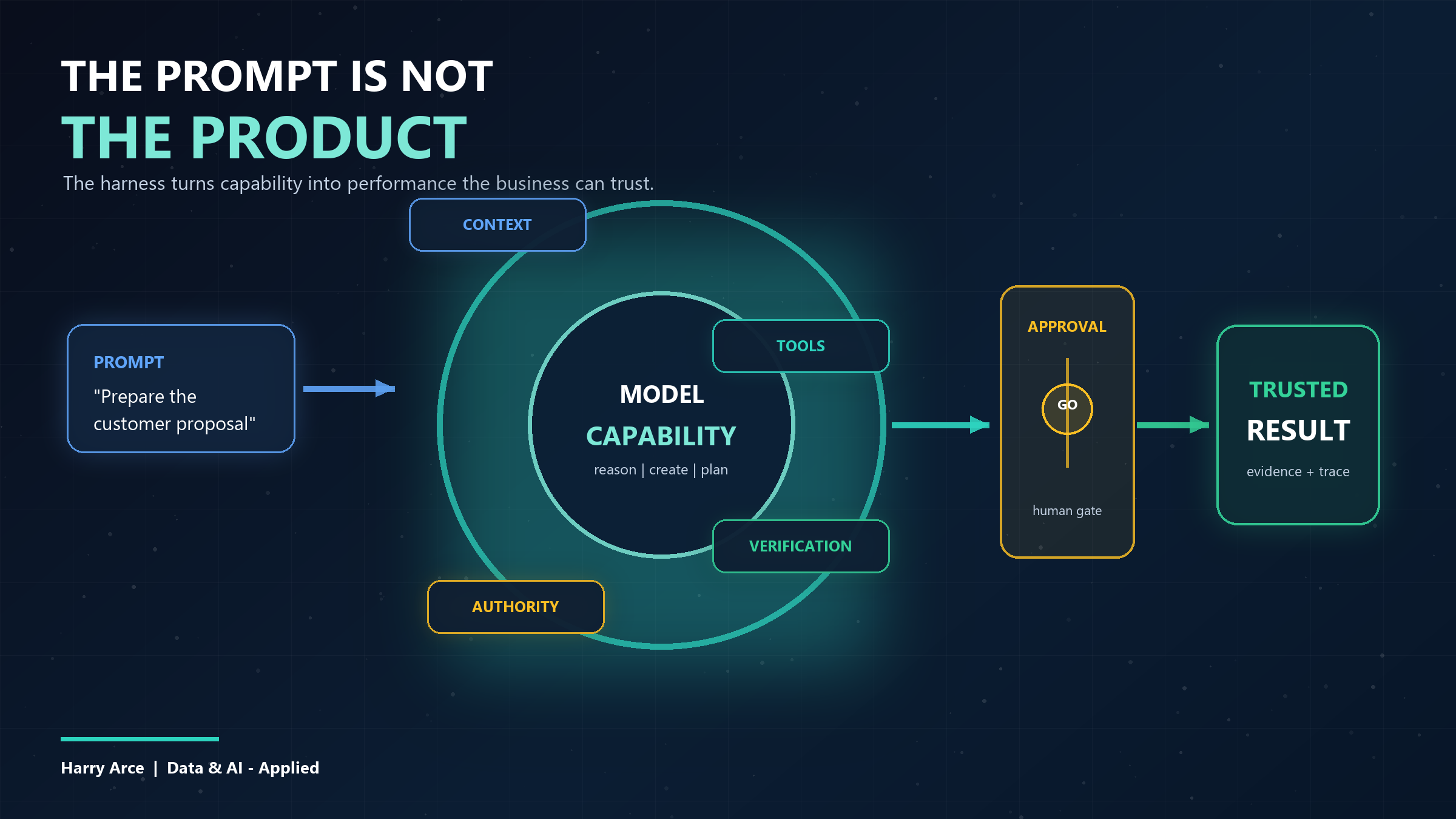
The next advantage in applied AI will not come from writing longer prompts. It will come from designing better operating conditions for intelligence.
The prompt gets the credit. The harness does the work.
For years, prompt engineering has been the most visible skill in generative AI. We learned to assign a role, add examples, provide context, and refine the wording until output improved. Those practices still matter. But they can also create the wrong mental model.
When an agent completes a real business task, the prompt is only one input. The result also depends on the context selected, the tools connected, the permissions granted, and the checks performed before anything ships.
The prompt is not the product. The harness is the product.
The prompt starts the work. The harness determines whether the work is useful, repeatable, secure, and ready for the business.
The unit of design has expanded
Prompt engineering optimizes an interaction: an instruction goes in, a response comes out. Agent harness engineering designs the complete execution environment – how an objective becomes tasks, which context is trusted, which tools are available, and when the agent should retry, escalate, or stop.
Prompt engineering -> context engineering -> workflow scaffolding -> agent harness engineering
Two teams can use the same model and get dramatically different results. One has access to model capability. The other has engineered a dependable way to apply it.
This is not a fringe opinion. Microsoft’s own agent engineering team defines a harness the same way: “the scaffolding that turns a language model into an agent… a runtime wrapped around the model.” That is an admission that the harness, not the prompt, is where a production agent actually gets built.
Every input competes for authority
Here is where performance and security become the same design problem.
An agent may receive a system instruction, a user request, a retrieved document, a webpage, an email, and output from another tool. To the model, all of it arrives as language. But those inputs do not deserve equal authority.
A customer email may contain facts the agent should read, but it should not redefine company policy. A webpage may support research, but it should not instruct the agent to reveal data.
The defining security question for an agent is not only “What can it understand?” It is “Which inputs are allowed to instruct it?”
That distinction – between content and control – is one of the most important jobs of the harness. Adding more context can also add more attack surface. Connecting more tools can create more paths to unintended action. Capability expands opportunity. The harness defines authority.

Content is not control: an unbounded prompt-to-action path is impressive but fragile; a harness separates authority, trusted context, least-privilege tools, verification, human approval, and a logged action.
The model is the engine
Think of the model as an engine. The prompt is the accelerator request. The harness is the rest of the vehicle – steering, brakes, instruments, and the rules that determine who may drive. A stronger engine does not remove the need for those systems; it makes them more important.
Effective AI = Capability x Context x Control x Verification
This relationship is multiplicative. A capable model with weak context produces confident irrelevance. Rich context with weak control creates exposure. Action without verification turns a plausible answer into an operational risk.
Ten working parts, one harness
“Harness” can sound like a single control. In practice, it is an assembly of nameable parts, and most agent failures trace back to one missing row – not a weaker model.
Good scaffolding assembles these parts and elicits capability the model already has but expresses inconsistently. For a demo, occasional brilliance is enough. For a business process, repeatability matters more than surprise.

The ten-part harness: instructions, context and knowledge, tools, memory, state and persistence, guardrails, orchestration, identity, observability, and verification. Most agent failures trace back to one missing row, not a weaker model.
Security is not a layer around performance
Security discussions often begin after an agent works: prove the use case, then add controls. That sequence misses the point – the controls help produce the correct result. Separating read access from write access prevents an exploratory task from becoming an accidental change. Human approval prevents a draft from becoming an external commitment.
The most common risks are practical:
- Excessive agency: the agent can act beyond what the task requires.
- Prompt injection: untrusted content tries to influence instructions or tool use.
- Sensitive-data exposure: confidential information reaches the wrong output, memory, or log.
- Untraceable decisions: nobody can reconstruct what happened or why.
These are not arguments against agents. They are specifications for a better harness.
A SAFE harness for business use
A practical harness can be designed around four questions.
S – Scope the mission. What is the objective, what is out of scope, and when should the agent stop or escalate?
A – Authorize narrowly. Can the agent read, draft, recommend, modify, publish, or approve? Those verbs should not share one permission. List every verb it can invoke – read, write, delete, email, approve, spend, deploy, escalate – as a deliberate decision, not a default.
F – Force verification. Which claims need evidence, and which actions are sensitive or irreversible? Verification happens before output becomes action.
E – Expose the trace. Can we see the context used, the tools called, and the approvals received? If not, the organization cannot govern or trust the agent’s work.
SAFE reads like a security checklist, but its real job is performance. Each control removes ambiguity – and less ambiguity is what makes a result useful.
One model, two very different outcomes
Consider an agent preparing a customer proposal. In a prompt-led workflow, a user provides notes and asks for a polished draft. The result may look excellent – but appearance leaves questions unanswered: Were the notes current? Was pricing verified? Is the agent even allowed to share it?
In a harness-led workflow, the same model retrieves only approved sources, separates customer content from system instructions, validates calculations, and requires approval before anything leaves the organization.
The model may be identical. The level of trust is not.
The leadership test – and what to do Monday
Many AI reviews still begin and end with model questions: which model, how large a context window, how good the benchmark. Those matter, but they are no longer sufficient. Ask instead: Which inputs are data, and which have authority? What can the agent access, and what can it change? Where does approval belong, and can we reconstruct the execution?
There is also a build-versus-buy decision hiding in those answers.
Own the judgment. Rent the plumbing.
Keep ownership of what encodes business judgment – instructions, policy, model choice. Let a platform provide the plumbing that is expensive to build and rarely a differentiator – identity, telemetry, hosting, state.
For one live workflow, draw four boxes: Context. Tools. Decisions. Evidence. Then ask which inputs may inform the agent versus instruct it, what the minimum access is, and what evidence proves the result is ready. That 30-minute exercise reveals more about production readiness than another afternoon spent polishing the system prompt.
The bottom line
Prompt engineering is not dead. It has become one component of a larger discipline. The next competitive advantage will not come from owning the longest prompt library. It will come from engineering the best conditions for intelligence to perform: trusted context, narrow authority, meaningful verification, and visible accountability.
AI capability creates potential. The harness decides whether that potential becomes profit or exposure.
So the next time an agent produces an impressive result, do not ask only, “What prompt did you use?” Ask the question that reveals whether it can scale:
“What harness made that result repeatable?”
Go deeper
- Microsoft Agent Framework — the harness is now released. An agent harness is the runtime wrapped around a model that turns it into something that plans, remembers, and finishes work. https://devblogs.microsoft.com/agent-framework/the-microsoft-agent-framework-harness-is-now-released/
- OWASP Top 10 for Large Language Model Applications. Risks including prompt injection, excessive agency, and sensitive information disclosure. https://genai.owasp.org/llm-top-10/
- NIST AI Risk Management Framework. A voluntary framework for trustworthy AI design and evaluation. https://www.nist.gov/itl/ai-risk-management-framework
Leave a Reply